Published June 13, 2026
AI and the ‘Gift of Time’
I dove into a feverish creative weekend sprint to find out if new AI workflows actually save time, or just expand the scope of problems to solve.
by Gregg Thompson
00
The Theory
I’m sitting having lunch at a Portuguese café with a co-worker directly across from the creative production company we both worked at.
GenAI video is starting to improve, and we’ve been trading contemplations about the future of tech, film and the creative industries.
“What AI will give us,” she says to me, without the faintest whiff of irony, “is the gift of time.”
She goes on to say that because we will be able to do so much more, so much quicker, with so much less, countless hours of mind-numbing human labour will be freed up.
“And if our work is done ahead of schedule,” she continues, “we should be able to go home early.”
I try to imagine competitor agencies, film production companies and startups all taking early lunches.
Colour me unconvinced.
I decide to get some dirt under the fingernails and test my friend’s theory.
01
The Challenge
Friday · 7:05pm
52 hours 55 minutes to deadline
I’m knee deep in a self-imposed creative fever-sprint for the weekend.
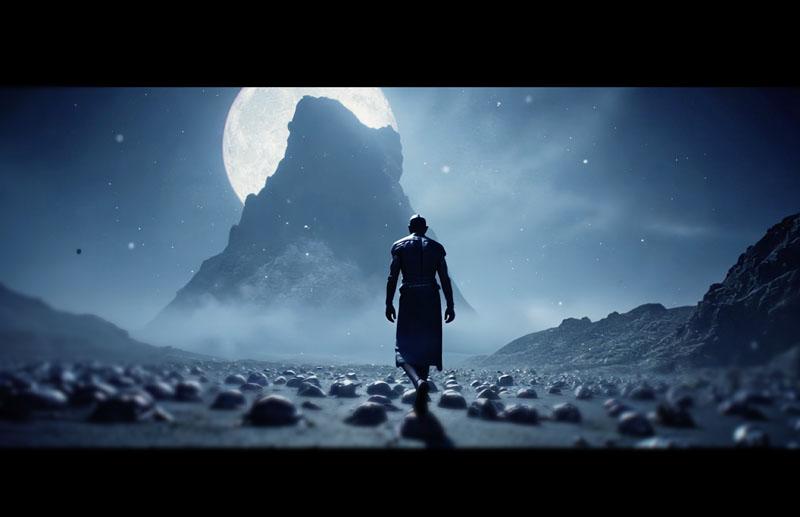
Starting Friday after work, I’ve given myself a hard deadline of midnight Sunday to complete a proof-of-concept trailer for a sci-fi world I’ve been squirrelling away on for years - Dead Moon.
From experience, I know that 10 minutes of doing - hands on inside a real creative process - is worth more than countless hours of pontificating about said process from the outside.
I also know that these creative sprints are often as painful as they are rewarding. Like a dog with a bone, once I start, I can’t let the work go until it’s right.
But perhaps this time, armed with a suite of GenAI tools, it will be different.
Perhaps this time will not be as painful.
It will be a fluid, organic, trance-like process.
It may even be ‘fun’.
And I may get to do normal bi-pedal life-form type-things on Sunday.
My friend’s enticing words may have taken root in my mind after all.
02
Still Directing
Saturday · 1:15am
46 hours 45 minutes to deadline
After some false starts, the trailer is taking shape. I’m finding a rhythm.
I’m also monitoring the process as I go.
Is there a better way to do this?
Are my years of experience working for or against me?
Am I using latest best practice, or just defaulting to legacy tools and behaviour?
Part of the process I’ve settled on is to hit the dictate button on my mac and lateral-roll thoughts and instructions directly into an LLM. Just as I would with past collaborators on countless shoots for trailers, TVCs, music videos, shorts, series.
Directing.
Guiding crew and talent.
Communicating with producers, writing partners, editors, VFX teams.
I describe the shots to the LLM just as I see them, in as much detail as I can muster.
Framing. Lensing. Light source. Camera movement.
And not just visual information.
Concept. Character. Narrative. Drama. Emotion.
I pour this all out while pacing around my standing desk.
The tools have changed. The cognitive process is strikingly similar.
You have a vision - great.
The real skill is still putting that vision into someone else’s head clearly enough that they can help make it real.
Even if that someone else happens to be a Generative, Pre-trained Transformer.
03
Generic Is as Generic Does
Saturday · 3:10am
44 hours 50 minutes to deadline
Dead Moon is a world where humans are merging with technology.
There are those who lean in to this technology, and those who reject it.
(I promise that this idea is from many, many years ago.)
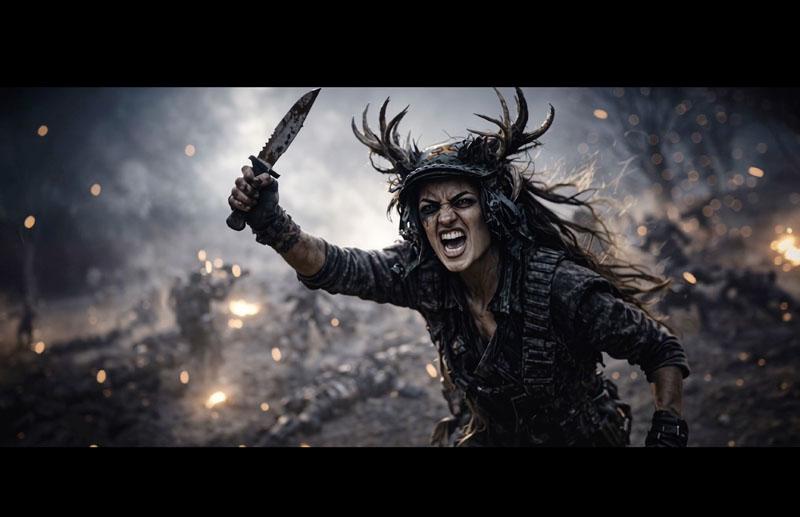
I have a character called Feral, from one of the tribes that rejected the technology.
Feral is a young woman who grew up in the wild and modelled her physical, and psychological, defences on the animals around her.
For the trailer, I have a scene with her hunting. She eyes a wild ‘stag’ in a clearing. A moment passes between them - the hunter and the hunted.
The scene works, but it’s overly familiar.
How can I keep the moment, but angle it away from cliché?
Wouldn’t it be interesting if the stag had a mechanical prosthetic leg? Something natural and wild, but artificially augmented.
It changes the meaning of Feral’s reaction, and sparks questions for both us and her:
How did this prosthetic happen?
Who put it there and why?
This narrowing of the ideation → realisation refractory period is not a minor change to the creative process - it’s profound. After this weekend, I’m still wrapping my head around the full implications.
Previously I’d need to wait days, weeks or months for a VFX shot to be modelled, rendered and submitted for approval. Now I can see almost instantly if a moment is working - both technically and creatively - and respond and iterate immediately.
That silent impulse that guides all creatives - this way, not that - is working at a faster rate.
The misty screen of the mind can be very forgiving. We’re all geniuses in our own heads. But now it’s immediately obvious if something is working. And seeing ideas this quickly, and this objectively, demands early action. Hard decisions can’t be delayed until later in the process.
There are also risks in working this way.
You could slip into the creative death spiral of ‘one more generation’.
But with discipline, and a deadline, this is powerful stuff.
04
Hybrid Processes
Saturday · 10:20am
37 hours 40 minutes to deadline
This bloody trailer makes no sense. It’s just a cold open with moody, atmospheric SFX pads.
It needs context.
I decide on an opening line of voiceover to set up the world, establish the key conflict, and introduce a lead character.
In the past, I would often do a line reading for vocal artists to guide the exact timing and emphasis of the dialogue - much to the chagrin of the talent involved.
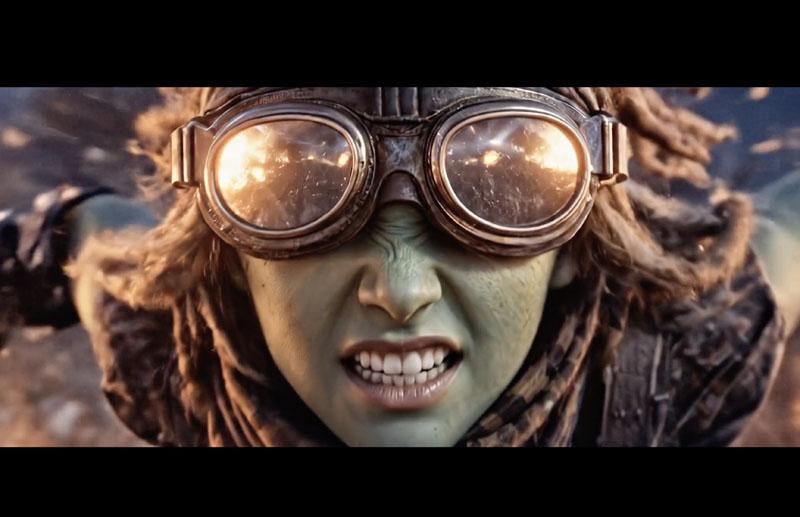
I can hear exactly how this particular line of VO should sound. The only problem is that the character delivering it is a 12-year-old girl named Glider.
Of course, I would still prefer to work with actors (for the most part), but this is a money-losing sci-fi passion project. And I have only hours left to ship this trailer.
I record the line in my natural baritone, with the exact delivery I hear in my head.
I pass this recording through various voice models until I find one close enough to Glider’s timbre.
I expect a generic AI voice, like on the social clips I skip with an eye-roll.
But the voice is 90% accurate to the one I had in my mind.
The nuance of my delivery carries over entirely to the new version - even the invented alien words.
The result is, frankly, stunning.
05
Human Fingerprints
Saturday · 3:35pm
32 hours 25 minutes to deadline
I need a shot of Glider approaching an eerie city at dusk.
A few days before, I’d tried an experiment of automatic drawing on A2 newsprint with a 3mm lead drafting holder - just letting the arm sweep over the page until something emerged.
I wasn’t sure what the image was at first. It looked like an extreme close up of a strange insect.
Then I flipped the object relationships in my mind.
What if instead of a macro shot, it was a wide landscape?
And what if this tiny insect was not tiny at all, but unimaginably vast?
A fossil.
A relic.
And what if there were people living within it - an alien tribe that assembled around the skeletal remains of this ancient, long-forgotten creature.
I like that.
I scan the sketch and upload it as reference.
AI, by definition, creates nothing new, they say.
Creativity is, by definition, the art of the new, they say.
(My mind rifles through the generic, strikingly LLM-esque top grossing films of the past few decades. I swat this thought away.)
But what if you bring the ‘new’ creative to the predictive AI model as you work with it?
And then steer, wrangle and cajole the model away from its mediocre mean.
Just as you would steer, wrangle and cajole teams away from mediocrity on any project.
A cityscape from a drawing.
Characters from 3D sculptures.
The results feel different because the provenance is different.
My literal and figurative fingerprints are on these shots.
06
The Money Shot
Sunday · 11:40pm
20 minutes to deadline
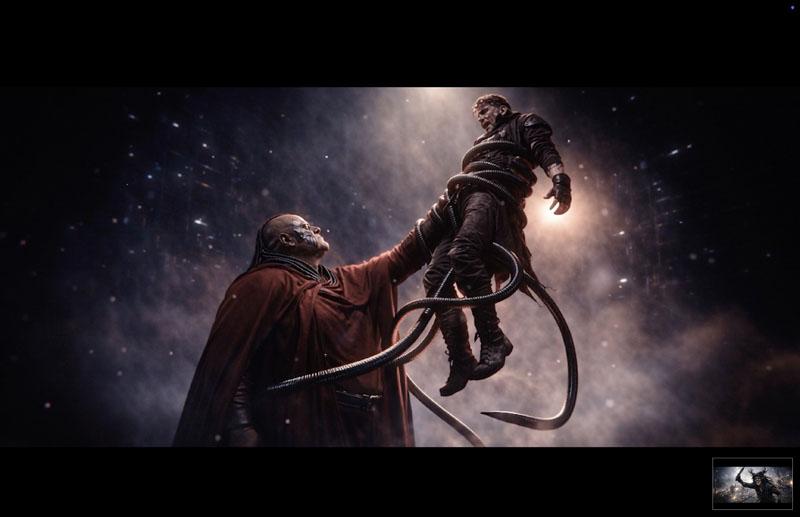
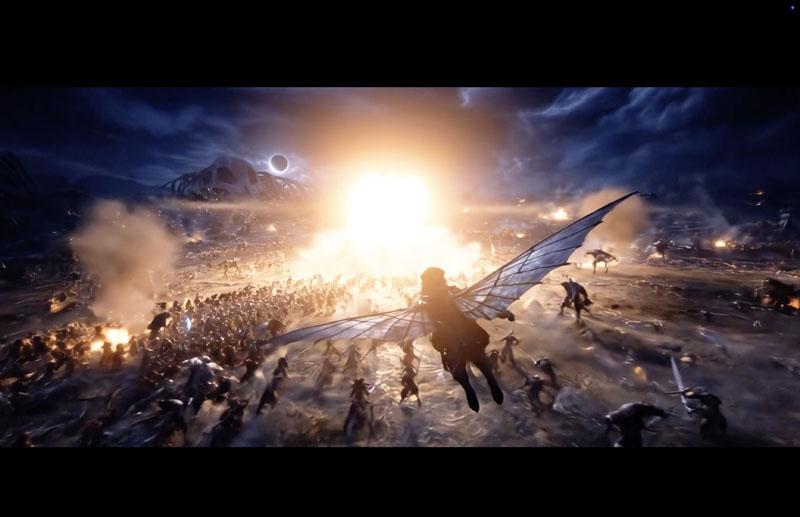
I’m ending the trailer in a rising cascade of quick-fire shots across key characters, environments, and story beats.
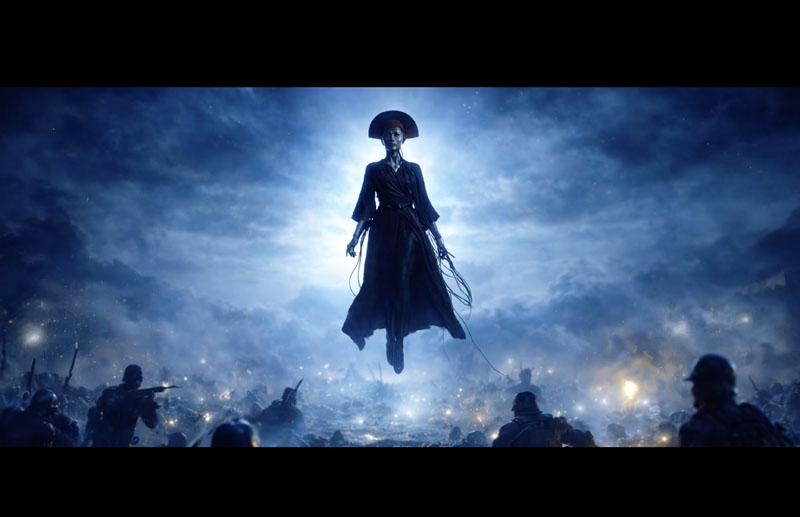
I need one final shot of Glider, flying high above the battlefield, as the skeletal cityscape is under siege.
I pace around my workspace, ranting into the mic about every aspect of this shot.
The image generation is solid, but when I see the first video render I hear myself say out loud:
“Oh my God.”
It is almost exactly the shot that was flickering on the screen of my mind.
The previous shots feel tame by comparison.
I need to think grander. Bolder. More intense.
I need to go back and redo everything.
But mercifully, there’s no time left.
5 minutes to deadline
I hit export.
07
Same-Same, But Different
Monday · 12:17am
Deadline passed. Trailer submitted.
The weekend was surprisingly similar to other intense creative sprints I’ve done.
The ideation.
The iteration.
The relentless interrogation of whether a moment has earned its place, or is as good as it can be.
This is the same as it’s always been.
But I see a few different categories of processes emerging:
Traditional Processes That Matter
Speaking, writing, drawing, performing.
There’s a strength to work that begins life through a core human process.
But it’s an intangible strength.
Does it really matter for all flavours of work?
Unclear.
Hybrid Processes
Traditional line readings become voice-model direction.
Hand-drawn sketches drive image and video generation.
Static facial sculptures steer generated characters.
Old craft feed directly into new tools.
New Processes - TBD
Not all ideas start life as thoughts.
Some begin as a vague impulses.
A feeling.
Sound.
Scent.
New processes will emerge as interfaces and models evolve. Creative workflows are sure to become more intuitive, fluid, and organic. New layer of abstraction above various creative techniques.
Perhaps old processes will be deprecated.
Or find a new place in the workflow.
Or become a creative or stylistic choice.
But core human capabilities.
Thinking.
Outsource these at your peril.
08
The Real Gift
Alas, my friend’s theory was only partially correct.
Yes, AI did give me the ‘gift of time’, in a sense. But it was not idle time.
It was not time to knock off early.
Or work less.
Or take a long lunch.
It was the opposite.
It was time to push the creative harder, and further than before.
Because I could see the creative outcomes sooner.
Judge them earlier.
Iterate on them faster.
The gift was of greater creative heights.
And both the means, and obligation, to reach them.